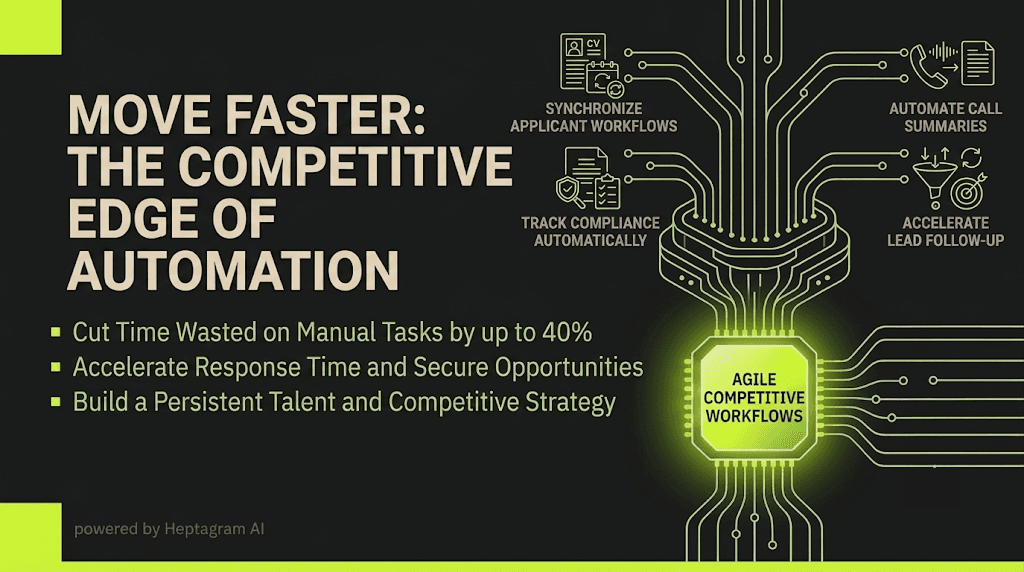
7 in 10 business leaders identify speed and nimbleness as their primary competitive strategy for the next three years. Yet most organizations are still bogged down in manual processes.
Organizations that fail to respond with speed and precision could risk significant talent disadvantages. The gap between leaders and laggards is widening.
The Fragmentation Tax
Your competitors are automating. They are building persistent talent pools. They are automating lead follow-up. They are reducing after-call work. They are cutting costs. They are moving faster.
| What Competitors Automate | What You Do Manually |
|---|---|
| Candidate screening and scheduling | Copy-paste from email to ATS |
| Lead follow-up and qualification | Manual emails and call logs |
| Call transcription and summarization | Typing notes from memory |
| Workforce planning and forecasting | Spreadsheets and guesswork |
| Compliance tracking and reporting | Manual audits and checklists |
The Industry Data
According to the 2026 Competitive Strategy Report, organizations that have implemented workflow automation are 2.5x more likely to report revenue growth above industry average. The gap between leaders and laggards is widening at 15% per year.
The Cost of Inaction
| Cost Factor | Impact |
|---|---|
| Labor Costs | 40% of time wasted on manual tasks |
| Opportunity Costs | Delayed responses lead to lost deals |
| Compliance Costs | Manual errors lead to violations |
| Competitive Advantage | Slower execution leads to market share loss |
| Talent Costs | Manual work leads to lower retention |
The Solution: Heptagram AI
Heptagram AI builds custom automation systems for growing companies. We do not sell SaaS subscriptions. We build proprietary automation layers on your infrastructure.
Why you own the infrastructure
When we build your automation, you are not renting a platform. You are building an automation layer on top of your own infrastructure. The system runs on your cloud account or on your own servers. You control the data. You control the security. You control the updates.
No monthly subscription fees per seat. No vendor lock-in. No surprise price increases. You pay for the build once. You maintain control forever.
FAQ
How do I know if my competitors are automating?
Look at their time-to-market. Look at their cost structure. Look at their growth rate. If they are moving faster and cheaper, they are automating.
What is the risk of not automating?
Slower execution. Higher costs. Lower margins. Competitor advantage. Talent attrition.
What should I automate first?
Audit your operational bottlenecks. Where do you spend the most manual time? Where are the highest error rates? Where are the biggest delays? Start there.
Conclusion & CTA
Your competitors are automating. They are pulling ahead. The gap is widening.
Book a zero-risk 15-minute scoping call to map your biggest operational bottleneck. We will tell you if automation makes sense for your organization. And we will tell you if it does not.
[Book Your Scoping Call]
Want a system like this built for you?
Book a discovery call and we'll scope what it takes to automate your workflow.
Book a discovery callRelated
The Death of the Demo: Why "Schedule a Demo" Is the Worst CTA in Enterprise Software
Enterprise buyers are tired of demos. The new winning strategy is leading with industry expertise and honest problem-solving.
Why 82% of Leaders Believe AI Can Only Deliver ROI If It Understands Business Nuance
Generic AI does not understand your industry's nuances. 82% of leaders say that is the only way AI delivers meaningful ROI.
The Hidden Cost of AI: Why Token-Based Pricing Is Killing Your ROI
Token-based AI pricing can be 10-20x more expensive than workflow-led architectures. Here is how to cut AI costs without sacrificing outcomes.