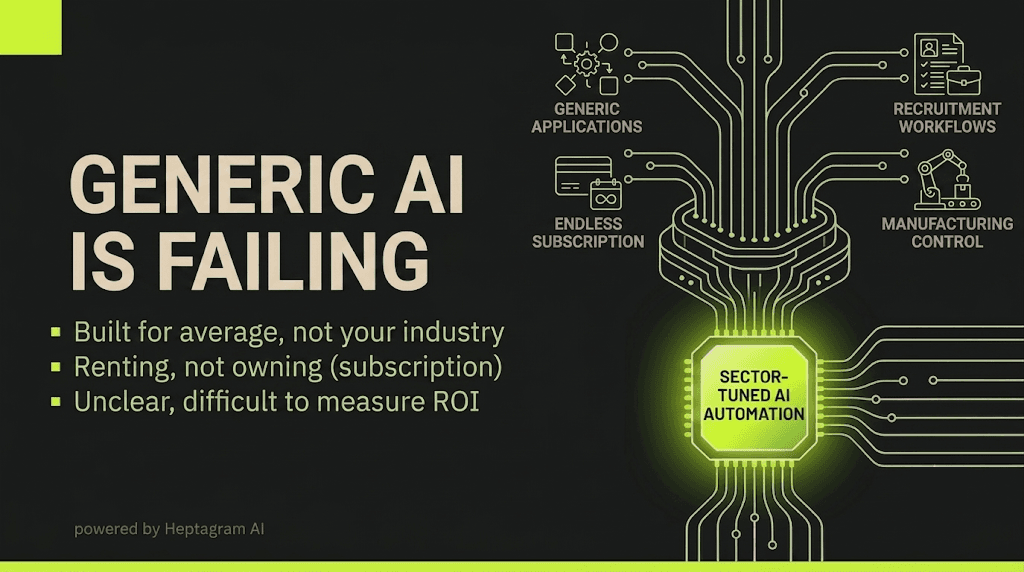
82% of leaders believe AI can only deliver meaningful ROI if it understands the nuances of how the business operates. Yet most AI tools are generic. They do not understand industry-specific workflows, regulations, or pain points.
Generic AI is failing because it is built for the average use case. Recruitment agencies have different needs than manufacturing plants. Healthcare providers have different needs than construction firms. The middle of the bell curve does not exist in any real industry.
The Fragmentation Problem
Generic AI tools operate on a subscription model. You pay per seat every month. You never stop paying. The tool never becomes yours. The data lives on their servers. The automations live on their infrastructure. You are renting.
| Failure Point | What Goes Wrong |
|---|---|
| Generic Tools | Built for average use case, not your industry |
| Subscription Pricing | Pay forever, never own |
| Data Control | Data on vendor servers |
| Customization | Limited to vendor's roadmap |
| ROI | Unclear and difficult to measure |
The Industry Data
According to the 2026 AI Strategy Report, 82% of leaders believe AI can only deliver meaningful ROI if it understands the nuances of how the business operates. Only 23% say their current AI tools meet this standard.
The Sector-Specific Alternative
Sector-specific automation is built from the ground up for your industry's workflow patterns. It integrates with your existing tools rather than replacing them. It automates the steps that are specific to your operational bottlenecks.
Comparison Table
| Metric | Generic AI | Sector-Specific Automation |
|---|---|---|
| Industry Understanding | Surface-level | Deep operational knowledge |
| Integration | Limited to vendor's ecosystem | Connects to your existing tools |
| Customization | Configurable within limits | Built for your specific needs |
| Pricing Model | Perpetual subscription | One-time build |
| ROI | Difficult to measure | Clear and measurable |
The Solution: Heptagram AI
Heptagram AI builds sector-specific automation systems for growing companies. We do not sell SaaS subscriptions. We build proprietary automation layers on your infrastructure.
Why you own the infrastructure
When we build your automation, you are not renting a platform. You are building an automation layer on top of your own infrastructure. The system runs on your cloud account or on your own servers. You control the data. You control the security. You control the updates.
No monthly subscription fees per seat. No vendor lock-in. No surprise price increases. You pay for the build once. You maintain control forever.
FAQ
Why does AI need to understand business nuance?
Because every industry has specific workflows, regulations, and pain points. Generic tools automate the wrong things faster.
What is the difference between generic AI and sector-specific automation?
Generic AI is built for the average use case. Sector-specific automation is built for your industry's specific needs.
How do I know if I need sector-specific automation?
If your operational bottlenecks are unique to your sector, you need sector-specific automation. If a generic tool cannot explain how it solves your specific problems, it will not deliver ROI.
Conclusion & CTA
Generic AI is failing. Sector-specific automation is the path to real ROI.
Book a zero-risk 15-minute scoping call to map your biggest operational bottleneck. We will tell you if automation makes sense for your organization. And we will tell you if it does not.
[Book Your Scoping Call]
Want a system like this built for you?
Book a discovery call and we'll scope what it takes to automate your workflow.
Book a discovery callRelated
The Death of the Demo: Why "Schedule a Demo" Is the Worst CTA in Enterprise Software
Enterprise buyers are tired of demos. The new winning strategy is leading with industry expertise and honest problem-solving.
Why Your Competitors Are Automating What You're Still Doing Manually
7 in 10 leaders cite speed as their primary competitive strategy. If you are not automating, your competitors are pulling ahead.
The Hidden Cost of AI: Why Token-Based Pricing Is Killing Your ROI
Token-based AI pricing can be 10-20x more expensive than workflow-led architectures. Here is how to cut AI costs without sacrificing outcomes.