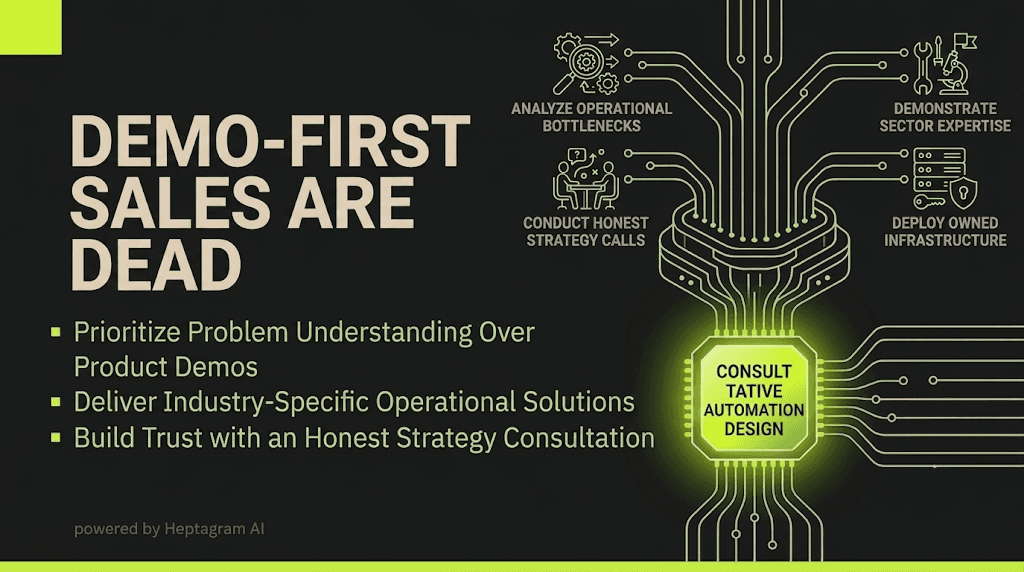
Enterprise buyers are tired of demos. They have seen hundreds of them. They know the demo will show the best-case scenario, not how the product actually works in their industry.
The traditional "schedule a demo" CTA is dead. Buyers do not want to see your product. They want to know if you understand their problem.
The Fragmentation Problem
The old enterprise software sales model was built on demos. You show the product. You show the features. You show the dashboard. You ask for the sale.
| Old Model | New Model |
|---|---|
| Show the demo | Show you understand the problem |
| Features and benefits | Operational solutions |
| Generic pitch | Industry-specific expertise |
| Push for sale | Build trust first |
| SaaS subscription | Owned infrastructure |
The Industry Data
According to the 2026 Enterprise Buying Report, 73% of enterprise buyers say vendor industry expertise is more important than product features. 68% say they are more likely to buy from a vendor that offers an honest consultation before a demo.
The New Winning Strategy
The shift in enterprise software buying is from "show me what you can do" to "show me you understand my problem." Buyers want vendors who can speak their industry's language. They want vendors who can tell them when automation does not make sense.
| Success Factor | Implementation |
|---|---|
| Problem-First Approach | Start with the operational bottleneck |
| Industry Expertise | Speak the language of the buyer's sector |
| Honest Assessment | Tell the buyer when automation does not work |
| Consultative Selling | Build trust before selling |
| Owned Infrastructure | Offer control over data and costs |
The Solution: Heptagram AI
Heptagram AI's approach is consultative and honest. We do not start with a demo. We start with a strategy call.
"Book a strategy call. Fifteen minutes, no contract, no deck. Tell us the process costing your team the most time and we will tell you whether it is worth automating including when it is not."
Why this works
It builds trust. It shows expertise. It demonstrates honesty. It positions the buyer as the expert on their business. It positions Heptagram AI as the expert on automation.
FAQ
Why is "schedule a demo" a bad CTA?
Because buyers have seen hundreds of demos. They know the demo will show the best-case scenario. They want to know if you understand their problem first.
What should I do instead?
Lead with industry expertise. Lead with problem understanding. Lead with honesty about when automation does not make sense. Start with a strategy call, not a demo.
How does consultative selling improve conversion?
It builds trust. It shows expertise. It demonstrates honesty. Buyers buy from vendors they trust.
Conclusion & CTA
The demo is dead. Problem-first, consultative selling is the future.
Book a zero-risk 15-minute scoping call. No deck. No contract. Just an honest conversation about whether automation makes sense for your business.
[Book Your Scoping Call]
Want a system like this built for you?
Book a discovery call and we'll scope what it takes to automate your workflow.
Book a discovery callRelated
Why Your Competitors Are Automating What You're Still Doing Manually
7 in 10 leaders cite speed as their primary competitive strategy. If you are not automating, your competitors are pulling ahead.
Why 82% of Leaders Believe AI Can Only Deliver ROI If It Understands Business Nuance
Generic AI does not understand your industry's nuances. 82% of leaders say that is the only way AI delivers meaningful ROI.
The Hidden Cost of AI: Why Token-Based Pricing Is Killing Your ROI
Token-based AI pricing can be 10-20x more expensive than workflow-led architectures. Here is how to cut AI costs without sacrificing outcomes.