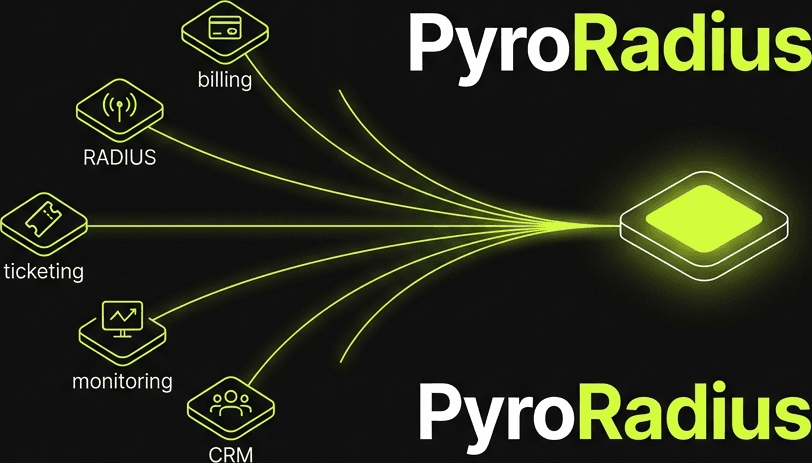
Splynx has been a default choice for small-to-mid WISPs and FTTH operators for years — it's a known quantity, with a large installed base and a mature feature set. ISPs searching for alternatives are usually not doing so because Splynx is bad; they're doing it because they've hit a specific limitation: integration friction with existing FreeRADIUS setups, per-subscriber pricing that scales awkwardly, or a feature gap around a specific piece of network hardware they run.
Why ISPs Look for a Splynx Alternative
The recurring themes in ISP operator forums and WISPA (Wireless Internet Service Providers Association) community discussions tend to cluster around a few specific pain points rather than a general dissatisfaction:
- Billing and RADIUS/AAA living in systems that don't integrate cleanly, requiring manual reconciliation
- Monitoring for specific hardware (Huawei OLTs, MikroTik routers) needing a separate tool bolted on
- Per-subscriber pricing that gets expensive as the subscriber base grows past a few thousand
- CRM and support ticketing living outside the billing platform entirely
Direct Comparison
| Capability | Splynx | PyroRadius |
|---|---|---|
| Billing + invoicing | ✅ Mature, widely used | ✅ Built-in |
| RADIUS/AAA integration | Via FreeRADIUS module, some setup overhead | Native, designed around FreeRADIUS from the ground up |
| Network hardware monitoring | Partner/plugin dependent | Built-in for common ISP hardware (OLT, router) |
| CRM + support tickets | ✅ Included | ✅ Included, same data model as billing |
| Pricing structure | Per-subscriber tiers | Per-unit, transparent — see PyroRadius pricing |
| Installed base / maturity | Large, long-established | Newer, purpose-built for the FreeRADIUS-first gap |
Splynx's maturity and installed base are real advantages — a larger ISP with an already-working Splynx deployment and no acute pain point has little reason to migrate. The case for PyroRadius is strongest for ISPs specifically frustrated by billing/RADIUS integration friction or by needing several separate tools (billing, monitoring, CRM) to run day-to-day operations.
What "One Platform for ISP Ops" Actually Means
The core pitch of any all-in-one ISP platform lives or dies on whether the pieces genuinely share data or are just bundled under one login. The test worth applying to any platform, PyroRadius included:
- Does a subscriber's billing status automatically reflect in their RADIUS session — i.e., does non-payment actually trigger a real disconnect without manual intervention?
- Does network hardware monitoring feed into the same subscriber record as billing and support?
- Can a support ticket see billing and connection history without switching tools?
- What does migration off the platform look like — is subscriber and billing history exportable in a usable format?
FAQ
Is switching from Splynx to another platform disruptive? Any billing platform migration carries real risk — subscriber data, active RADIUS sessions, and billing history all need careful migration. This should be planned as a project, not a weekend switch, regardless of destination platform.
Does PyroRadius support the hardware most WISPs already run? PyroRadius is built around common ISP hardware including Huawei OLTs and MikroTik routers — worth confirming specific model support directly for a given deployment.
Is per-unit pricing actually cheaper than per-subscriber tiers? It depends on subscriber count and growth trajectory — per-unit pricing tends to scale more predictably as a subscriber base grows, but the specific numbers should be compared directly against current Splynx tier pricing for an honest answer.
Does PyroRadius replace a separate CRM and ticketing tool? Yes — CRM and support ticketing run on the same data model as billing and RADIUS, rather than as a bolted-on separate system.
Further Reading and Sources
- WISPA — Wireless Internet Service Providers Association
- PyroRadius — FreeRADIUS Billing Integration: Why ISPs Run Five Tools
- PyroRadius — Pricing
One billing, RADIUS, and monitoring platform instead of three synced ones. Explore PyroRadius →
Want a system like this built for you?
Book a discovery call and we'll scope what it takes to automate your workflow.
Book a discovery callRelated
FreeRADIUS Billing Integration: Why Most ISPs Still Run Five Disconnected Tools
FreeRADIUS handles authentication well and nothing else. Most ISPs bolt on a separate billing system, CRM, ticketing tool, and monitoring dashboard around it — here is why that stack is expensive, and what a unified alternative looks like.
PyroRadius: Replacing Five ISP Tools With One Operations Platform
PyroRadius unifies RADIUS/AAA, billing, CRM, ticketing, and network monitoring behind one dashboard, so every system shares the same subscriber record.