FreeRADIUS is, by a wide margin, the most widely deployed open-source RADIUS server in the ISP world. It handles authentication, authorization, and accounting — the AAA in RADIUS AAA — reliably and for free. What it doesn't do, by design, is billing, customer relationship management, support ticketing, or network monitoring.
That's not a flaw in FreeRADIUS. It was never meant to be a full operations platform. But it means every ISP running it as their authentication backbone has to solve the rest of the operations stack separately — and most do, with four or five different tools that don't share data with each other or with FreeRADIUS itself.
The Market Context
The scale of this problem is visible in how large the OSS/BSS category has become as ISPs and telecom operators try to solve it. Market sizing varies by research firm, but the direction is consistent: Future Market Insights values the global OSS/BSS market at $96.4 billion in 2026, up roughly 12.5% year-on-year, while IMARC Group's analysis puts the broader market at $72 billion in 2025, growing toward $156.1 billion by 2034 at an 8.7% compound annual rate. The cloud-specific OSS/BSS segment alone is projected to grow from $43.35 billion in 2025 to $59.02 billion by 2032.
Whichever figure is used, the underlying driver is the same: rapid digitalization of telecom infrastructure, the shift to fiber and 5G, and — critically for smaller ISPs and WISPs — integration of AI-driven service management into what used to be manual operations work.
The Typical Five-Tool Stack
For an ISP running FreeRADIUS as the authentication layer, the rest of the stack usually looks something like this:
| Function | Typical Separate Tool | What Doesn't Talk to FreeRADIUS |
|---|---|---|
| Authentication (AAA) | FreeRADIUS | — |
| Billing & invoicing | Separate billing platform | Subscriber plan changes require manual sync |
| CRM / customer records | Spreadsheet or separate CRM | Support history disconnected from account status |
| Support ticketing | Separate helpdesk tool | Agents can't see live connection status |
| Network monitoring | Separate NMS (e.g., for MikroTik, Huawei OLTs) | Outage data disconnected from support tickets |
Each arrow in that table is a manual sync, a spreadsheet export, or a support agent switching between four browser tabs to answer one customer call. None of it is broken, exactly — it's just slow, error-prone, and expensive to maintain as the subscriber base grows.
What Breaks First as an ISP Scales
Small ISPs can run this fragmented stack manually for a while. The breakage becomes visible at a specific point — usually somewhere past a few thousand subscribers — where:
- Billing and RADIUS session data drift out of sync. A customer who's suspended for non-payment in the billing system but not disconnected in RADIUS keeps getting service; a customer who paid but whose RADIUS entry wasn't updated gets wrongly disconnected. Both generate support tickets.
- Support agents can't see the full picture in one place. Answering "why is my internet down" requires checking network monitoring, then RADIUS session status, then the billing system for account standing — across three separate logins.
- Provisioning new subscribers requires manual entry into multiple systems — RADIUS, billing, CRM — rather than one action that updates all three.
- ISP billing solutions increasingly need to handle prepaid and postpaid models, subscription billing, and protocol-specific requirements (PPPoE, DSL, FTTH) natively rather than as an afterthought bolted onto a generic billing tool.
What a Unified Platform Actually Removes
The fix isn't replacing FreeRADIUS — it's wrapping AAA, billing, CRM, ticketing, and monitoring around a single subscriber record instead of five separate ones. Concretely, that means:
- One subscriber record that RADIUS, billing, support, and monitoring all read from and write to — a plan change in billing immediately reflects in RADIUS session policy.
- Support agents see everything in one screen — account status, live connection status, billing history, open tickets — without switching tools.
- Provisioning a new subscriber is one action, not four.
- Network events (an OLT outage, a MikroTik interface flapping) automatically correlate with support tickets, rather than support agents discovering the outage from angry calls before the NOC does.
How PyroRadius Approaches This
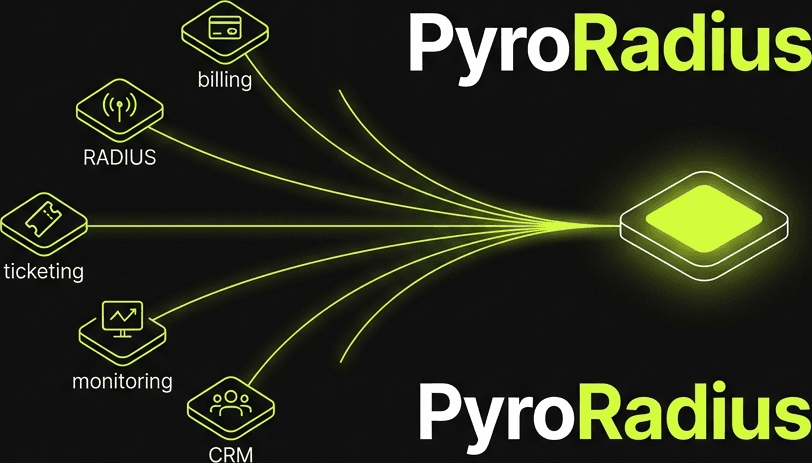
PyroRadius is built specifically around this problem: RADIUS, billing, CRM, ticketing, and network monitoring on one platform, sharing a single subscriber record rather than five disconnected ones. The stated outcome is direct — one platform replaces five licenses and the integration work between them, and support resolves faster because every system shares the same subscriber data.
For ISPs already running FreeRADIUS, this isn't a rip-and-replace of the authentication layer that already works — it's removing the four other tools stitched around it and the manual sync work that comes with keeping them all current.
FAQ
Does moving to a unified platform mean abandoning an existing FreeRADIUS deployment? Not necessarily — the goal is unifying the operational layers (billing, CRM, ticketing, monitoring) around the subscriber record; existing RADIUS/AAA infrastructure and configuration can often be preserved rather than rebuilt from scratch.
What size ISP actually needs this, versus being fine with manual tools? The fragmented-stack problem is manageable for very small subscriber bases handled by one or two people who know every system. It becomes a real operational cost once support volume and subscriber count grow enough that manual cross-referencing between tools starts producing errors and slow resolution times.
Does a unified platform support both PPPoE and FTTH/GPON billing models? ISP billing needs to handle prepaid and postpaid billing, subscription models, and protocol-specific requirements across DSL, PPPoE, and FTTH — a genuinely unified ISP platform needs to support this range natively rather than requiring separate billing configurations per connection type.
How does network monitoring integration actually help support response time? When an OLT or router event is visible to the same system handling support tickets, an agent can immediately see "this customer's outage matches a known network event" instead of troubleshooting from zero on every call during an outage.
FreeRADIUS solved authentication. It was never supposed to solve the other four tools stacked around it. Explore PyroRadius →
Want a system like this built for you?
Book a discovery call and we'll scope what it takes to automate your workflow.
Book a discovery callRelated
Splynx Alternative: How PyroRadius Compares on ISP Billing and Management
ISPs evaluating Splynx alternatives usually care about three things: billing accuracy, RADIUS/AAA integration, and how many separate tools the platform actually replaces. Here is a direct, honest comparison.
PyroRadius: Replacing Five ISP Tools With One Operations Platform
PyroRadius unifies RADIUS/AAA, billing, CRM, ticketing, and network monitoring behind one dashboard, so every system shares the same subscriber record.