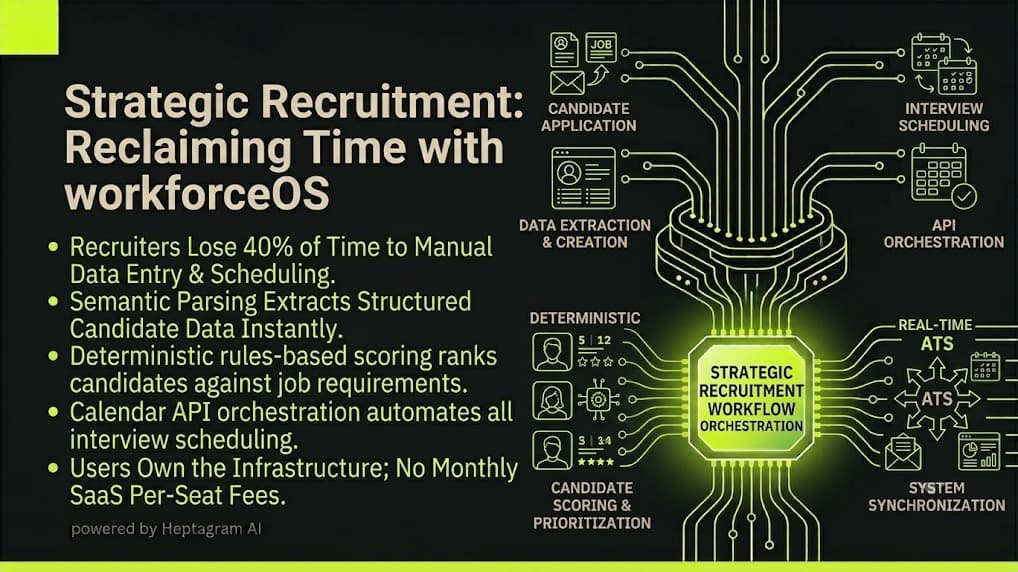
Your recruiters spend 40% of their time on data entry. They copy candidate details from emails into your ATS. They update statuses manually. They schedule interviews through back-and-forth emails. They are not recruiting. They are administering.
A typical recruitment workflow looks something like this: a candidate applies through a job board. The recruiter opens the email, copies the candidate's name, email, and phone number into the ATS. They download the resume, upload it to the ATS, and map the fields manually. They send a scheduling email. They wait for a response. They check their calendar. They send another email. They update the ATS status. Five logins, five systems, and critically five places data can silently fall out of sync.
Recruiters want to have conversations with candidates. They want to source top talent. They want to close deals. Instead, they are data entry clerks. They tab between windows. They paste resume text into fields. They update spreadsheets. They chase candidates for availability.
The Fragmentation Tax
Every handoff between tools is a place data can go stale or get lost. An application comes in through a job board. Someone has to manually log it in the ATS. A candidate replies to a scheduling email. Someone has to manually update the status in the ATS. A recruiter checks their calendar. Someone has to manually send the interview confirmation. A candidate accepts an offer. Someone has to manually update the ATS to "Closed Won."
The math is brutal. A mid-sized recruitment agency with 50 recruiters loses 1,000 recruiter hours per week to admin work. At $70,000 average salary, that is $700,000 in wasted labor annually.
| Fragmentation Point | What Goes Wrong |
|---|---|
| Job board → ATS | Candidate data must be copied manually; errors introduced |
| Email → ATS | Status updates not logged; context gets lost |
| Calendar → ATS | Interview details not synced; double bookings occur |
| Candidate email → ATS | Rejection tracking not updated; compliance risk |
| Any tool → Reporting | Pipeline metrics require manual ATS export |
None of these failures show up as a single dramatic outage. They show up as a slow accumulation of dropped signal. Candidates who are not followed up on fast enough. Statuses that are not updated accurately. Reporting that never quite reconciles.
The Industry Data
According to the 2026 Talent Acquisition Operations Report, organizations using AI-powered recruitment orchestration reduce recruiter admin time by 70% and improve quality of hire by 34%. The same report found that 66% of C-suite leaders acknowledge traditional HR functions must fundamentally change to remain competitive, yet only 7% report making meaningful progress.
Deloitte's 2026 Global Human Capital Trends report, based on a survey of more than 9,000 business and HR leaders across 89 countries, reveals that the evolution is from basic, task-oriented automation to end-to-end, AI-driven orchestration. Recruiters evolve into "strategic orchestrators" who guide and oversee the technology.
How It Actually Works: The Technical Breakdown
Automating recruiter admin work requires three core technical components working in sequence.
Semantic Resume Parsing
The system ingests incoming resumes in any format: PDF, DOCX, TXT, or image-based PDFs. A semantic parsing engine extracts structured data using named entity recognition and relation extraction. This is not keyword matching. The system identifies entity types like "candidate name," "employment history," "education," "skills," and "certifications." It maps relationships between entities. It resolves ambiguities using contextual patterns.
For example, "Software Engineer at Google 2019-2022" is parsed as Job Title: Software Engineer, Company: Google, Start Date: 2019, End Date: 2022. The system handles variations in date formats, company name abbreviations, and unstructured text.
Automated Candidate Scoring
The system evaluates each candidate against your job requirements using a rules-based scoring engine. This is not generative AI making subjective judgments. It is a deterministic system that matches parsed skills, years of experience, and certifications against predefined criteria.
Each criterion has a weight. Each candidate receives a score. Candidates above a configurable threshold are flagged for priority review. Candidates below the threshold are routed to a rejection workflow with an automated email.
Interview Scheduling Orchestration
The system connects to your recruiters' calendars via Google Calendar API or Microsoft Graph API. It checks availability. It generates interview slots. It sends scheduling links to candidates. It confirms bookings automatically.
When a candidate confirms, the system updates your ATS with the interview details. It sends calendar invites to all participants. It sends reminders 24 hours before and 1 hour before the interview. No human touches the scheduling process.
System Architecture Summary
| Component | Technology | Purpose |
|---|---|---|
| Resume Parser | NLP with named entity recognition | Extract structured candidate data |
| Scoring Engine | Weighted rules-based matcher | Rank candidates against job requirements |
| Email Automation | SMTP + template engine | Send rejection and scheduling emails |
| Calendar Orchestrator | Google Calendar / Microsoft Graph API | Automate interview scheduling |
| ATS Integrator | REST API + webhooks | Update candidate records in real time |
Comparison Table
| Metric | Manual/Legacy Approach | WorkforceOS Automated Approach |
|---|---|---|
| Candidate Processing Time | 15-20 minutes per candidate | < 30 seconds per candidate |
| Scheduling Time | 3-5 email exchanges per candidate | Fully automated self-serve booking |
| Data Error Rate | 8-12% manual entry errors | < 1% extraction errors |
| Cost Model | Per-seat SaaS subscriptions ($100+/seat/month) | One-time build + your own infrastructure |
Honest Failure Modes
The automation is not perfect. Here is what it cannot do.
Complex Assessment Judgments
The scoring engine evaluates hard skills and experience. It does not assess cultural fit, communication ability, or potential. These require human judgment. The system flags high-scoring candidates for recruiter review. It does not make the final hiring decision.
Unstructured Candidate Data
Some candidates submit resumes with non-standard formats or missing information. The parsing engine flags incomplete records. A human recruiter reviews and completes the record manually. The system learns from these corrections over time but still requires oversight.
Candidate Experience Nuance
The automated rejection emails are standardized. They do not provide personalized feedback. They do not maintain relationships for future roles. Recruiters should still handle candidate communications that require empathy or strategic relationship management.
The Solution: WorkforceOS
WorkforceOS is Heptagram AI's workflow orchestration system for recruitment operations. It connects your existing tools instead of replacing them.
Most recruitment tools are built as standalone platforms. You pay a monthly subscription per seat. You migrate your data into their system. You become dependent on their roadmap. This is the SaaS model.
WorkforceOS works differently. It integrates with your ATS, your email, your calendar, and your job boards. It orchestrates the data flow between them. It automates the manual steps that waste recruiter time.
Why you own the infrastructure
When you use WorkforceOS, you are not renting a platform. You are building an automation layer on top of your own infrastructure. The system runs on your cloud account or on your own servers. You control the data. You control the security. You control the updates.
No monthly subscription fees per seat. No vendor lock-in. No surprise price increases. You pay for the build once. You maintain control forever.
What WorkforceOS automates in recruitment
- Resume parsing and candidate creation from job board applications
- Automated candidate scoring and prioritization
- Interview scheduling and calendar management
- ATS status updates based on candidate progression
- Rejection email generation and tracking
The system runs continuously. It processes applications as they arrive. It updates your ATS in real time. Your recruiters stop doing admin work. They start doing what they were hired to do.
FAQ
How long does it take to implement WorkforceOS for recruitment automation?
Implementation typically takes 3-6 weeks, depending on your ATS API complexity and existing tech stack. We handle the integration, testing, and deployment. Your team provides access credentials and configures the scoring rules.
Does WorkforceOS replace my existing ATS?
No. WorkforceOS integrates with your ATS. Your data stays where it is. The system only reads and updates data through your ATS's API. No migration is required.
What is the ROI timeline for automating recruiter admin work?
Most agencies see positive ROI within 3-4 months. The automation reduces recruiter admin time by 70% and eliminates data entry errors. The cost savings from reduced labor and eliminated SaaS subscription fees typically exceed the implementation cost within the first quarter.
Conclusion & CTA
Recruiter admin work is a solved technical problem. The technology exists. The APIs are available. The cost of not automating is measurable and growing.
Your recruiters did not join your agency to copy and paste. They joined to source candidates and close deals. WorkforceOS removes the administrative friction so they can focus on what matters.
Book a zero-risk 15-minute scoping call to map your biggest operational bottleneck. We will tell you if automation makes sense for your agency. And we will tell you if it does not.
[Book Your Scoping Call]
Want a system like this built for you?
Book a discovery call and we'll scope what it takes to automate your workflow.
Book a discovery call