63% of US candidates have now been interviewed by AI. 47% in the UK. 36% in Ireland. AI-assisted hiring is no longer a niche experiment. It is the new normal.
Yet organizations have averaged only 21% maturity in qualifying candidates inline after they click apply. The interview process is still largely manual and inconsistent.
The Fragmentation Tax
A typical interview workflow looks something like this: a recruiter screens a candidate. They schedule an interview with the hiring manager. The hiring manager interviews. They provide feedback. The recruiter collects feedback. They update the ATS. Five logins, five systems, and critically five places data can silently fall out of sync.
| Fragmentation Point | What Goes Wrong |
|---|---|
| Screening → Interview | Scheduling must be done manually; time lost |
| Interview → Feedback | Feedback not captured consistently; quality drops |
| Feedback → ATS | Status not updated; pipeline tracking fails |
| Interview → Decision | Decisions delayed; candidates drop off |
| Any tool → Reporting | Interview metrics require manual data gathering |
The Industry Data
According to the 2026 Talent Acquisition Report, 63% of US candidates have been interviewed by AI. Organizations using AI-powered interview platforms reduce time-to-hire by 40% and improve interview consistency by 50%.
How It Actually Works: The Technical Breakdown
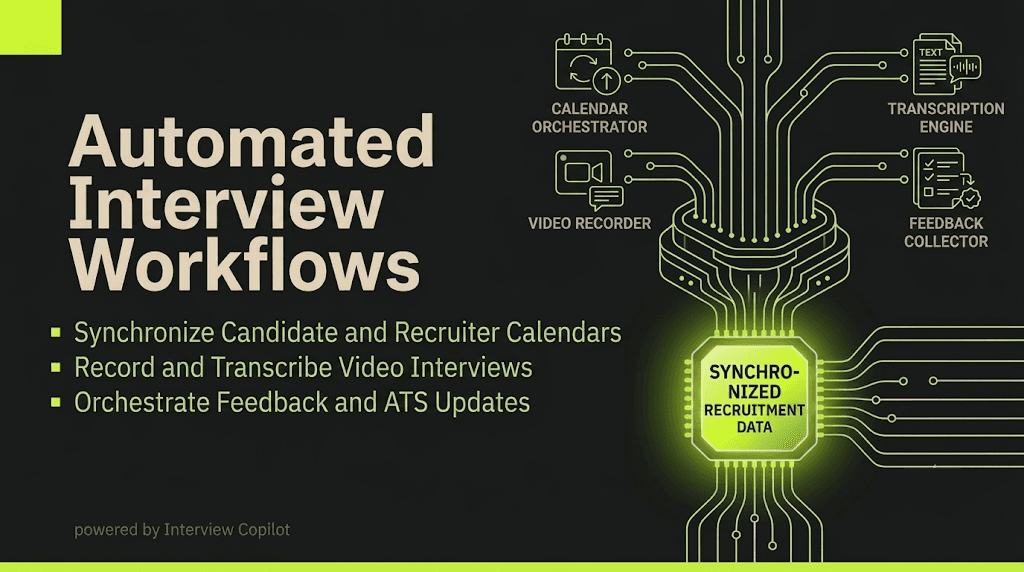
Automating the interview process requires three core technical components working in sequence.
Automated Interview Scheduling
The system connects to recruiters' and hiring managers' calendars via Google Calendar API or Microsoft Graph API. It generates interview slots based on availability. It sends scheduling links to candidates. It confirms bookings automatically.
Interview Recording and Transcription
The system connects to video interview platforms via API. It records interviews with candidate consent. It transcribes interviews using speech-to-text technology. It timestamps the transcript for easy reference.
Interview Analysis and Feedback Collection
The system processes interview transcripts. It identifies key topics. It extracts candidate responses. It generates interview summaries. It sends feedback forms to interviewers. It aggregates feedback scores. It updates the ATS with the decision.
System Architecture Summary
| Component | Technology | Purpose |
|---|---|---|
| Calendar Orchestrator | Google Calendar / Microsoft Graph API | Automate interview scheduling |
| Video Recorder | Video API + recording | Record interviews with consent |
| Transcription Engine | Speech-to-text | Transcribe interviews |
| Feedback Collector | Custom API + form templates | Gather and aggregate interview feedback |
Comparison Table
| Metric | Manual/Legacy Approach | Interview Copilot Automated Approach |
|---|---|---|
| Scheduling Time | 3-5 email exchanges per interview | Fully automated self-serve booking |
| Feedback Collection Time | 2-3 days | < 2 hours |
| Interview Consistency | Low (varies by interviewer) | High (standardized process) |
| Cost Model | Per-user ATS subscription ($150+/user/month) | One-time build + your own infrastructure |
Honest Failure Modes
The automation is not perfect. Here is what it cannot do.
Complex Candidate Assessment
The interview analysis identifies topics and extracts responses. It does not assess complex qualifications. It does not evaluate interpersonal skills. Human judgment is still required for final decisions.
Candidate Experience Nuance
The automated scheduling is efficient. It does not provide personalized candidate experience. Human recruiters should still handle candidate communications that require relationship-building.
The Solution: Interview Copilot
Interview Copilot is Heptagram AI's interview orchestration system for talent acquisition. It connects your existing ATS and scheduling tools instead of replacing them.
Most interview tools are built as standalone platforms. You pay a monthly subscription per seat. You become dependent on their roadmap. This is the SaaS model.
Interview Copilot works differently. It integrates with your ATS and calendar. It orchestrates the data flow between them.
Why you own the infrastructure
When you use Interview Copilot, you are not renting a platform. You are building an automation layer on top of your own infrastructure. The system runs on your cloud account or on your own servers. You control the data. You control the security. You control the updates.
No monthly subscription fees per seat. No vendor lock-in. No surprise price increases. You pay for the build once. You maintain control forever.
What Interview Copilot automates in recruitment
- Automated interview scheduling and calendar management
- Interview recording and transcription
- Interview summary generation and feedback collection
- ATS status updates based on interview decisions
- Interview analytics and reporting
FAQ
How long does it take to implement Interview Copilot?
Implementation typically takes 3-5 weeks, depending on your ATS API complexity and existing tech stack.
Does Interview Copilot replace my existing ATS?
No. Interview Copilot integrates with your ATS. No migration is required.
What is the ROI timeline for automating interviews?
Most recruitment teams see positive ROI within 2-3 months. The automation reduces time-to-hire by 40% and improves interview consistency.
Conclusion & CTA
Interview automation is the new standard. 63% of candidates have experienced it.
Book a zero-risk 15-minute scoping call to map your biggest operational bottleneck. We will tell you if automation makes sense for your recruitment team. And we will tell you if it does not.
[Book Your Scoping Call]
Want a system like this built for you?
Book a discovery call and we'll scope what it takes to automate your workflow.
Book a discovery call