Ask any recruiter what eats the most time in a week that isn't spent actually talking to candidates, and scheduling comes up almost every time. Finding a slot that works for a candidate, a hiring manager, and sometimes two more interviewers, across time zones, with reschedules landing constantly — it is coordination work, not recruiting work, and it has been solvable with software for years. Most agencies still do it by hand.
Why Scheduling Is Still Manual in 2026
The applicant tracking system tells you who to interview. It rarely tells you when they're both free. That gap gets filled with email threads, calendar invites sent one at a time, and a recruiter checking their own calendar against a hiring manager's before circling back to the candidate — often three or four message round-trips per interview, per candidate, repeated for every open role.
LinkedIn's Talent Solutions research on time-to-hire has repeatedly found that scheduling delays are among the largest contributors to candidate drop-off between offer-to-interview and interview-to-decision — not because candidates lose interest in the role, but because a slow, clumsy process reads as a preview of what working there will feel like.
What AI Interview Scheduling Actually Automates
The phrase "AI scheduling" covers a fairly specific set of mechanics, and it's worth being precise about which parts are automated and which still need a person.
| Task | Automated | Still Needs a Human |
|---|---|---|
| Finding mutual availability across calendars | ✅ Yes | — |
| Sending the invite and confirmation | ✅ Yes | — |
| Handling a reschedule request | ✅ Yes, with rules | Edge cases (VIP candidates, panel interviews) |
| Sending reminders (24h, 1h) | ✅ Yes | — |
| Deciding who should interview a candidate | — | ✅ Recruiter/hiring manager judgment |
| Reading interview signal and scorecards | — | ✅ Human evaluation |
The pattern that works is automating the coordination mechanics completely while leaving every judgment call — who interviews, what questions get asked, whether to extend an offer — with the people who should be making it. Scheduling automation that tries to also auto-select interviewers or auto-advance candidates tends to produce the kind of "the algorithm rejected me" complaints that show up in SHRM's coverage of AI hiring backlash — the fix isn't to avoid automation, it's to automate the right layer.
How This Fits Into WorkforceOS
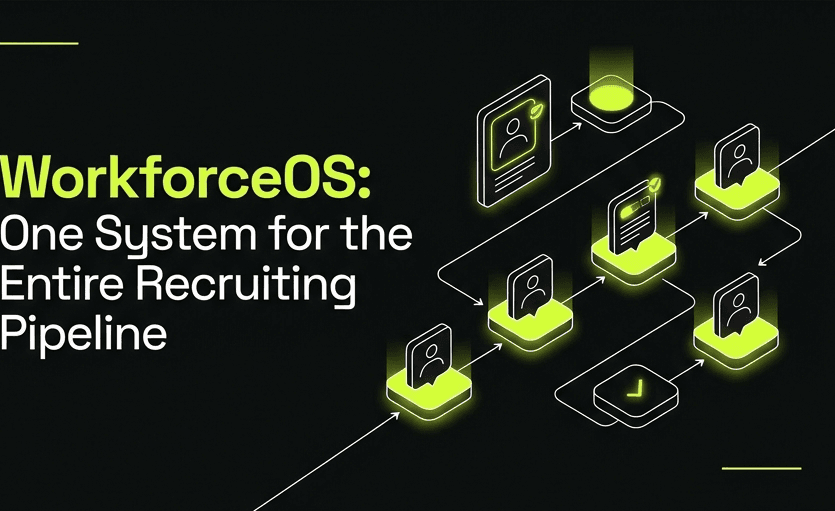
WorkforceOS treats scheduling as one stage in the pipeline, not a separate tool bolted on afterward. When a candidate clears screening, the system:
- Pulls interviewer availability directly from connected calendars
- Offers the candidate a set of real, bookable slots — no more "does Tuesday at 2 work?" emails
- Confirms automatically once a slot is picked and syncs it to every calendar involved
- Sends reminders and handles reschedule requests within rules the agency sets
- Logs the interview against the candidate record so the next stage has full context
Nothing about who gets interviewed or what happens in the room changes — the system removes the coordination tax around it.
What This Costs an Agency Doing It Manually
| Metric | Manual Scheduling | Automated Scheduling |
|---|---|---|
| Email round-trips per interview booked | 3–5 | 0–1 (candidate self-selects) |
| Recruiter time per scheduled interview | 10–20 minutes | Under 2 minutes |
| Reschedule handling | Manual, ad hoc | Rule-based, automatic |
| No-show rate (with automated reminders) | Baseline | Meaningfully lower — reminder cadence is the single biggest lever on no-shows |
Across a desk running dozens of interviews a week, that time difference compounds into hours a recruiter gets back for sourcing and candidate conversations — the parts of the job that actually require a person.
FAQ
Does AI scheduling replace the recruiter's role in deciding who gets interviewed? No. It automates the calendar mechanics of booking an already-decided interview. Who gets interviewed remains a recruiter and hiring-manager decision.
What happens when a candidate needs to reschedule? The system offers new mutual slots automatically within rules the agency configures, without a recruiter re-doing the coordination from scratch.
Does this work for panel interviews with multiple interviewers? Yes — it finds mutual availability across every calendar in the panel, which is exactly the case manual scheduling struggles with most as more people are added.
Will this reduce no-shows? Automated, consistent reminder cadences are one of the most reliable levers on no-show rates, since the biggest driver of a missed interview is simply forgetting it was scheduled.
Further Reading and Sources
- LinkedIn Talent Solutions — Time to Hire Benchmarks
- SHRM — AI Hiring Tools Face Growing Scrutiny
- SelectSoftwareReviews — Applicant Tracking System Statistics
Scheduling shouldn't be the reason a good candidate goes cold. Explore WorkforceOS →
Want a system like this built for you?
Book a discovery call and we'll scope what it takes to automate your workflow.
Book a discovery callRelated
Staffing Agency Software Buyer’s Guide 2026: What to Actually Evaluate
Most staffing agency software comparisons are feature checklists that miss the questions that actually predict whether a tool sticks. Here is a practical buyer’s guide, with a real evaluation framework and where WorkforceOS fits.
Recruitment CRM with AI Screening: What Staffing Agencies Should Check Before Switching Tools
Staffing agencies juggle client relationships and candidate pipelines at the same time — most CRMs were built for one or the other. Here is what a recruitment CRM with real AI screening needs to get right, and where WorkforceOS fits.
AI Resume Screening & Applicant Tracking Automation: Filtering Candidates Without Losing Quality
Most ATS filters are still keyword matches from 2015. Here is how AI resume screening actually works in 2026, what accuracy rates the best systems hit, and how WorkforceOS avoids the false-negative problem that quietly costs agencies their best candidates.