Your organization spends thousands of dollars on application automation. You have an ATS. You have job board integrations. You have career pages. Candidates click apply. The application lands in your system. Then nothing happens for three days.
The post-apply moment is the biggest gap in hiring automation. Organizations have averaged 62% maturity using automation to get candidates to click apply, but only 21% maturity to qualify them inline after the button is clicked.
A typical post-apply workflow looks something like this: a candidate applies. The application sits in the ATS. A recruiter reviews it manually. They decide to move forward or reject. They send an email. They wait for a response. They schedule an interview. They update the ATS. Five logins, five systems, and critically five places data can silently fall out of sync.
The Fragmentation Tax
Every handoff between tools is a place data can go stale or get lost. An application comes in. Someone has to manually review it. A candidate is qualified. Someone has to manually send a scheduling email. A candidate responds. Someone has to manually update the ATS status. A recruiter screens the candidate. Someone has to manually send feedback.
Fewer than 1% of organizations have a fully orchestrated end-to-end hiring automation flow. No industry scored above 30% on the hiring automation index overall.
| Fragmentation Point | What Goes Wrong |
|---|---|
| ATS → Recruiter | Applications wait days for review; candidates drop off |
| Recruiter → Email | Scheduling emails sent manually; time lost |
| Email → ATS | Status updates not logged; pipeline tracking fails |
| Recruiter → Feedback | Interview feedback not captured; quality drops |
| Any tool → Reporting | Pipeline metrics require manual ATS export |
None of these failures show up as a single dramatic outage. They show up as a slow accumulation of dropped signal. Candidates who are not followed up on fast enough. Statuses that are not updated accurately. Reporting that never quite reconciles.
The Industry Data
According to the 2026 Staffing Industry Analysts Hiring Automation Report, organizations that move beyond ad hoc AI adoption to intentional AI design are targeting greater hiring velocity, improved quality of hire, reduced cost-per-hire, and a measurably differentiated candidate experience.
The same report found that organizations using end-to-end hiring automation reduce time-to-hire by 40-50% and improve candidate satisfaction scores by 30%.
How It Actually Works: The Technical Breakdown
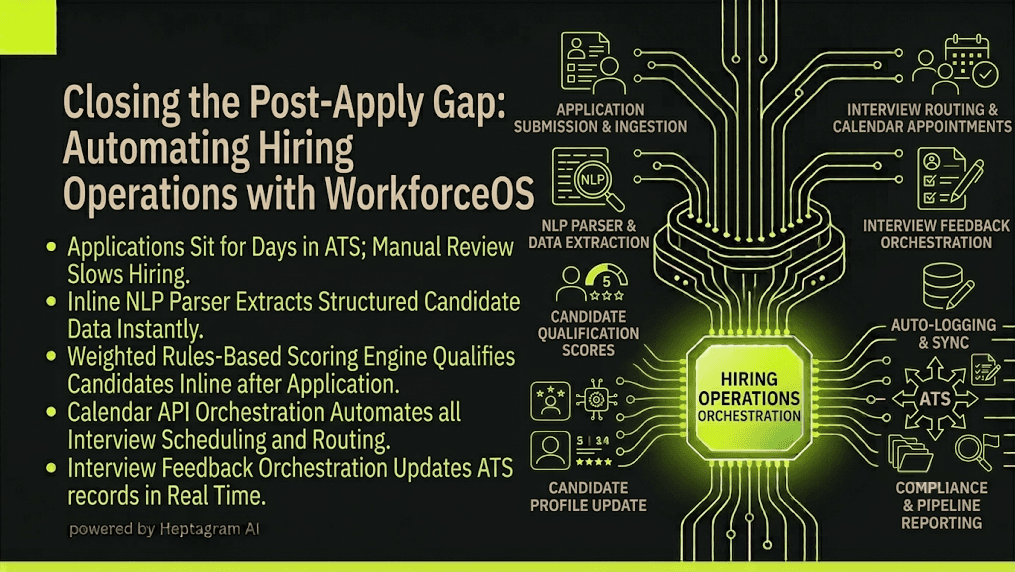
Automating the post-apply moment requires three core technical components working in sequence.
Inline Candidate Qualification
The system ingests the application immediately upon submission. It parses the resume using named entity recognition. It extracts candidate name, contact information, work history, education, and skills. It evaluates the candidate against your job requirements using a rules-based scoring engine.
The scoring engine matches parsed skills, years of experience, and certifications against predefined criteria. Each criterion has a weight. Each candidate receives a score. Candidates above a configurable threshold move forward. Candidates below the threshold receive an automated rejection email.
Automated Interview Routing
The system connects to your recruiters' calendars via Google Calendar API or Microsoft Graph API. For qualified candidates, the system generates interview slots based on recruiter availability. It sends scheduling links to candidates via email. It confirms bookings automatically.
When a candidate confirms, the system updates your ATS with the interview details. It sends calendar invites to all participants. It sends reminders 24 hours before and 1 hour before the interview.
Interview Feedback Orchestration
The system connects to your interview feedback tools via API. It sends feedback forms to interviewers before the interview. It collects feedback after the interview. It aggregates feedback scores. It updates the ATS with the decision.
If the candidate passes the interview, the system moves them to the next stage automatically. If the candidate fails, the system sends an automated rejection email.
System Architecture Summary
| Component | Technology | Purpose |
|---|---|---|
| Application Parser | NLP with named entity recognition | Extract structured candidate data |
| Scoring Engine | Weighted rules-based matcher | Qualify candidates inline |
| Calendar Orchestrator | Google Calendar / Microsoft Graph API | Automate interview scheduling |
| Feedback Collector | Custom API + form templates | Gather and aggregate interview feedback |
| ATS Integrator | REST API + webhooks | Update candidate records in real time |
Comparison Table
| Metric | Manual/Legacy Approach | WorkforceOS Automated Approach |
|---|---|---|
| Application-to-Interview Time | 3-5 days average | < 2 hours average |
| Candidate Drop-off Rate | 60-70% due to waiting | < 20% due to speed |
| Data Error Rate | 8-12% manual entry errors | < 1% extraction errors |
| Cost Model | Per-ATS subscription ($1,000+/month) | One-time build + your own infrastructure |
Honest Failure Modes
The automation is not perfect. Here is what it cannot do.
Complex Qualification Judgments
The scoring engine evaluates hard skills and experience. It does not assess cultural fit, communication ability, or potential. These require human judgment. The system flags high-scoring candidates for recruiter review. It does not make the final hiring decision.
Candidate Experience Nuance
The automated rejection emails are standardized. They do not provide personalized feedback. They do not maintain relationships for future roles. Recruiters should still handle candidate communications that require empathy or strategic relationship management.
Feedback Collection Edge Cases
The feedback collection system sends forms automatically. But some interviewers may not complete the forms. The system sends reminders but cannot force completion. Human oversight is still required for feedback collection.
The Solution: WorkforceOS
WorkforceOS is Heptagram AI's workflow orchestration system for hiring operations. It connects your existing tools instead of replacing them.
Most hiring tools are built as standalone platforms. You pay a monthly subscription per seat. You migrate your data into their system. You become dependent on their roadmap. This is the SaaS model.
WorkforceOS works differently. It integrates with your ATS, your email, your calendar, and your job boards. It orchestrates the data flow between them. It automates the manual steps that slow down hiring.
Why you own the infrastructure
When you use WorkforceOS, you are not renting a platform. You are building an automation layer on top of your own infrastructure. The system runs on your cloud account or on your own servers. You control the data. You control the security. You control the updates.
No monthly subscription fees per seat. No vendor lock-in. No surprise price increases. You pay for the build once. You maintain control forever.
What WorkforceOS automates in hiring
- Inline candidate qualification from job board applications
- Automated interview scheduling and calendar management
- Interview feedback collection and aggregation
- ATS status updates based on candidate progression
- Automated rejection email generation and tracking
The system runs continuously. It processes applications as they arrive. It updates your ATS in real time. Your recruiters stop doing admin work. They start doing what they were hired to do.
FAQ
How long does it take to implement WorkforceOS for post-apply automation?
Implementation typically takes 4-6 weeks, depending on your ATS API complexity and existing tech stack. We handle the integration, testing, and deployment. Your team provides access credentials and configures the scoring rules.
Does WorkforceOS replace my existing ATS?
No. WorkforceOS integrates with your ATS. Your data stays where it is. The system only reads and updates data through your ATS's API. No migration is required.
What is the ROI timeline for automating the post-apply moment?
Most staffing agencies see positive ROI within 3-4 months. The automation reduces time-to-hire by 40-50% and improves candidate satisfaction. The cost savings from reduced labor and eliminated SaaS subscription fees typically exceed the implementation cost within the first quarter.
Conclusion & CTA
The post-apply moment is a solved technical problem. The technology exists. The APIs are available. The cost of not automating is measurable and growing.
Your recruiters did not join your agency to do admin work. They joined to source candidates and close deals. WorkforceOS removes the administrative friction so they can focus on what matters.
Book a zero-risk 15-minute scoping call to map your biggest operational bottleneck. We will tell you if automation makes sense for your agency. And we will tell you if it does not.
[Book Your Scoping Call]
Want a system like this built for you?
Book a discovery call and we'll scope what it takes to automate your workflow.
Book a discovery call