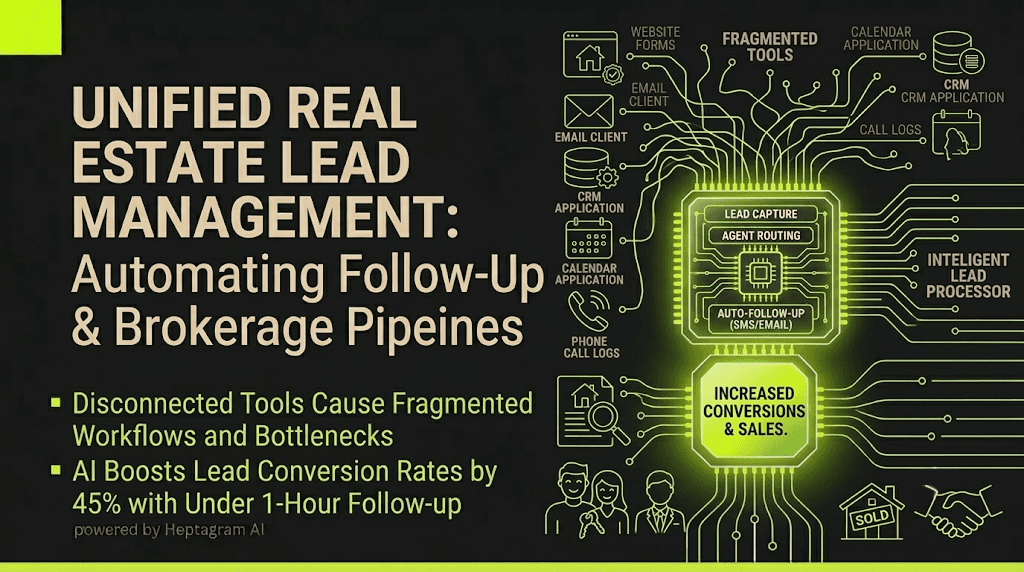
Your real estate agents spend 20% of their time on lead follow-up. They check email. They check CRM. They check their calendar. They try to remember who needs follow-up. They are not selling. They are chasing.
A typical real estate lead workflow looks something like this: a lead comes in from a website. The agent receives a notification. They call the lead. They log the call. They set a follow-up reminder. They wait. They call again. Five logins, five systems, and critically five places data can silently fall out of sync.
In real estate, lead follow-up is inconsistent and relies on individual agent effort. Most leads are never followed up with effectively, and opportunities are lost.
The Fragmentation Tax
Every handoff between tools is a place data can go stale or get lost. A lead comes in. Someone has to log it in the CRM. A follow-up is due. Someone has to remember to call. A lead replies. Someone has to log the response. A deal closes. Someone has to update the CRM.
| Fragmentation Point | What Goes Wrong |
|---|---|
| Website → CRM | Lead data must be logged manually; errors introduced |
| CRM → Follow-up | Follow-up reminders not set properly; leads go cold |
| Lead reply → CRM | Replies not logged; context gets lost |
| Deal closed → CRM | Status not updated; pipeline metrics inaccurate |
| Any tool → Reporting | Conversion metrics require manual CRM export |
The Industry Data
According to the 2026 Real Estate Automation Report, organizations using AI-powered lead management improve lead conversion rates by 45% and reduce follow-up response time from 24 hours to less than 1 hour. The same report found that brokerages with automated follow-up systems close 50% more deals.
How It Actually Works: The Technical Breakdown
Automating real estate lead follow-up requires three core technical components working in sequence.
Lead Capture and Routing
The system connects to your website via webhook. When a lead submits a form, the system creates a lead record in the CRM. It captures all lead details: name, contact information, property interest, and budget.
The system routes the lead to the appropriate agent based on territory, property type, or workload. It sends a notification to the agent. It creates a follow-up task with a configurable timeline.
Automated Follow-Up Orchestration
The system orchestrates follow-up sequences based on lead type and behavior. It sends automated SMS and email reminders at intervals: 1 hour, 24 hours, and 72 hours after lead capture. It logs all interactions in the CRM.
The system monitors lead engagement. If a lead opens an email or clicks a link, the system increases the lead score. If a lead does not engage, the system escalates to a phone call task.
Real-Time Status Tracking and Escalation
The system monitors lead status in real time. If a lead has not been contacted within 24 hours, the system escalates to a manager. If a lead has been in the pipeline for more than 30 days, the system flags for review.
When a deal closes, the system updates the CRM status to "Closed Won." It creates a task for post-sale follow-up. No manual data entry is required.
System Architecture Summary
| Component | Technology | Purpose |
|---|---|---|
| Lead Capture | Webhook + CRM API | Capture and create lead records |
| Lead Router | Rules-based assignment engine | Assign leads to agents automatically |
| Follow-Up Engine | SMS + email API | Orchestrate follow-up sequences |
| Engagement Monitor | Email/SMS tracking | Track lead engagement |
| Status Tracker | CRM API + status monitoring | Update lead status in real time |
Comparison Table
| Metric | Manual/Legacy Approach | LeadForge Automated Approach |
|---|---|---|
| Lead Follow-Up Time | 24 hours average | < 1 hour average |
| Lead Conversion Rate | 10-15% | > 20% |
| Lead Assignment Time | 2-3 hours | < 5 minutes |
| Cost Model | Per-agent CRM subscription ($100+/agent/month) | One-time build + your own infrastructure |
Honest Failure Modes
The automation is not perfect. Here is what it cannot do.
Complex Property Negotiation
The follow-up engine handles standard leads. It does not handle complex negotiations. It does not handle custom property requirements. These require human agents. The system escalates complex scenarios to agents.
Client Relationship Building
The automated system can engage leads. It can send reminders. It cannot build relationships. It cannot provide personalized property advice. Human agents are still required for relationship management.
Market Nuance
The system tracks lead status. It does not interpret market nuances. It does not provide pricing advice. Human agents are still required for market expertise.
The Solution: LeadForge
LeadForge is Heptagram AI's lead management system for real estate operations. It connects your existing CRM and website instead of replacing them.
Most lead management tools are built as standalone platforms. You pay a monthly subscription per user. You migrate your lead data into their system. You become dependent on their roadmap. This is the SaaS model.
LeadForge works differently. It integrates with your CRM, your website, and your communication tools. It orchestrates the data flow between them. It automates the manual steps that slow down conversions.
Why you own the infrastructure
When you use LeadForge, you are not renting a platform. You are building an automation layer on top of your own infrastructure. The system runs on your cloud account or on your own servers. You control the data. You control the security. You control the updates.
No monthly subscription fees per user. No vendor lock-in. No surprise price increases. You pay for the build once. You maintain control forever.
What LeadForge automates in real estate
- Lead capture and creation from website forms
- Automated lead routing and agent assignment
- Follow-up orchestration with SMS and email
- Real-time lead engagement monitoring
- Lead status tracking and escalation
The system runs continuously. It processes leads as they arrive. It updates your CRM in real time. Your agents stop chasing leads. They start closing deals.
FAQ
How long does it take to implement LeadForge for real estate?
Implementation typically takes 2-4 weeks, depending on your CRM API complexity and website integration requirements. We handle the integration, testing, and deployment. Your team provides access credentials and configures the follow-up rules.
Does LeadForge replace my existing CRM?
No. LeadForge integrates with your CRM. Your data stays where it is. The system only reads and updates data through your CRM's API. No migration is required.
What is the ROI timeline for automating lead follow-up?
Most brokerages see positive ROI within 2-3 months. The automation improves lead conversion rates by 45% and reduces follow-up time by 95%. The cost savings from increased conversions and eliminated SaaS subscription fees typically exceed the implementation cost within the first quarter.
Conclusion & CTA
Lead follow-up is a solved technical problem. The technology exists. The APIs are available. The cost of not automating is measurable and growing.
Your agents did not join your brokerage to chase leads. They joined to sell properties. LeadForge removes the administrative friction so they can focus on what matters.
Book a zero-risk 15-minute scoping call to map your biggest operational bottleneck. We will tell you if automation makes sense for your brokerage. And we will tell you if it does not.
[Book Your Scoping Call]
Want a system like this built for you?
Book a discovery call and we'll scope what it takes to automate your workflow.
Book a discovery call