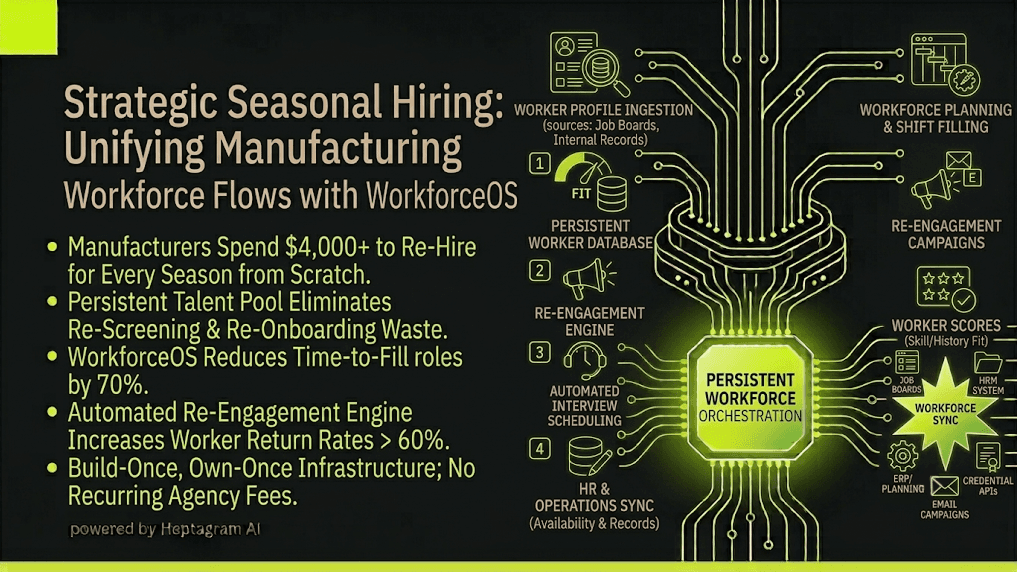
Your manufacturing plant spends $4,000 per seasonal hire. You recruit from scratch every season. You post job ads. You screen resumes. You interview candidates. You check credentials. You run background checks. You onboard. Then the season ends and you do it all over again.
A typical manufacturing seasonal hiring workflow looks something like this: a production manager requests workers. HR posts job ads. They screen applications. They schedule interviews. They verify credentials. They send offer letters. They conduct onboarding. Five logins, five systems, and critically five places data can silently fall out of sync.
Manufacturing created around 620,000 AI-adjacent positions in 2025. Yet high-volume shift hiring in manufacturing restarts from zero every season. The same candidates are re-screened repeatedly, and the cycle repeats.
The Fragmentation Tax
Every handoff between tools is a place data can go stale or get lost. A worker is hired for a season. Their data sits in the HR system. The season ends. They are laid off. Their data remains in the system but is not accessible to operations. Next season, HR starts from zero. They do not re-engage previous workers efficiently.
Industries with large frontline or operational workforces face the greatest AI preparedness challenges. Manufacturing is at the top of that list.
| Fragmentation Point | What Goes Wrong |
|---|---|
| Job boards → HR system | Applications must be reviewed manually; time lost |
| HR system → Operations | Worker availability not shared; understaffing occurs |
| Season end → Next season | Worker data not accessible; re-hiring restarts from zero |
| Credential verification → HR system | Credentials must be verified manually; compliance risk |
| Any tool → Planning | Workforce forecasting requires manual data gathering |
None of these failures show up as a single dramatic outage. They show up as a slow accumulation of dropped signal. Workers who are not re-engaged. Shifts that go unfilled. Compliance issues that are not caught.
The Industry Data
According to the 2026 Manufacturing Workforce Report, organizations using AI-powered workforce management reduce seasonal hiring costs by 40% and improve shift fill rates by 60%. The same report found that manufacturers with persistent talent pools reduce time-to-hire for seasonal workers by 70%.
Predictive robotic workforce intelligence is transforming industrial labor planning through AI scheduling engines, digital workforce twins, and real-time operational monitoring.
How It Actually Works: The Technical Breakdown
Building a persistent talent pool requires three core technical components working in sequence.
Unified Worker Database
The system creates a central worker database that persists across seasons. It captures worker data from multiple sources: job applications, previous employment records, credential verification systems, and onboarding documents.
The database stores worker profiles with structured fields: name, contact information, work history, skills, certifications, availability, and past performance. It tracks each worker's engagement history. It stores communication logs and feedback.
Automated Re-Engagement Engine
The system identifies known workers who have worked for you in the past. It sends automated re-engagement campaigns to available workers before the seasonal ramp. The campaigns are personalized based on each worker's history.
The system tracks response rates. It schedules interviews for interested workers. It verifies credentials automatically. It updates worker statuses in real time. No manual re-engagement is required.
Workforce Planning Dashboard
The system connects to your operations planning tools via API. It forecasts workforce needs based on production schedules. It compares forecasted demand against available workers. It identifies gaps before they become critical.
The dashboard displays real-time workforce availability. It shows which workers are available. It shows which credentials are current. It shows which workers are most likely to accept offers based on past engagement.
System Architecture Summary
| Component | Technology | Purpose |
|---|---|---|
| Worker Database | SQL with full-text search | Store and query persistent worker profiles |
| Re-Engagement Engine | Email API + template engine | Send personalized re-engagement campaigns |
| Credential Verifier | Third-party API integration | Verify licenses and certifications |
| Planning Dashboard | Custom visualization | Display workforce availability and gaps |
| Production Integrator | ERP API + webhooks | Forecast workforce needs based on schedules |
Comparison Table
| Metric | Manual/Legacy Approach | WorkforceOS Automated Approach |
|---|---|---|
| Seasonal Hiring Cost | $4,000+ per worker | < $2,000 per worker |
| Time-to-Fill Seasonal Roles | 3-4 weeks | < 1 week |
| Worker Re-Engagement Rate | < 20% from previous seasons | > 60% from persistent pool |
| Cost Model | Per-hire agency fees ($500+/worker) | One-time build + your own infrastructure |
Honest Failure Modes
The automation is not perfect. Here is what it cannot do.
Worker Decision Complexity
The re-engagement engine sends campaigns. It tracks responses. But it cannot predict worker decisions with 100% accuracy. Some workers will not respond. Some will accept other offers. The system provides forecasts but human judgment is still required for workforce planning.
Credential Verification Edge Cases
The credential verifier automates most checks. But some credential providers have complex verification processes. The system flags edge cases for human review. Compliance officers still verify complex credentials manually.
Seasonal Demand Forecasting
The system forecasts workforce needs based on production schedules. But demand fluctuations are not always predictable. The system can respond to changes but cannot predict every market shift. Human oversight is still required for workforce planning.
The Solution: WorkforceOS
WorkforceOS is Heptagram AI's workforce orchestration system for manufacturing and frontline operations. It connects your existing HR and operations systems instead of replacing them.
Most workforce management tools are built as standalone platforms. You pay a monthly subscription per seat. You migrate your worker data into their system. You become dependent on their roadmap. This is the SaaS model.
WorkforceOS works differently. It integrates with your HR system, your operations planning tools, and your credential verification systems. It orchestrates the data flow between them. It automates the manual steps that waste time and money.
Why you own the infrastructure
When you use WorkforceOS, you are not renting a platform. You are building an automation layer on top of your own infrastructure. The system runs on your cloud account or on your own servers. You control the data. You control the security. You control the updates.
No monthly subscription fees per seat. No vendor lock-in. No surprise price increases. You pay for the build once. You maintain control forever.
What WorkforceOS automates in manufacturing
- Persistent worker database that tracks all candidates
- Automated re-engagement campaigns for past workers
- Real-time credential verification and tracking
- Workforce forecasting based on production schedules
- Shift filling and worker scheduling automation
The system runs continuously. It tracks worker availability across seasons. It updates your HR system in real time. Your HR team stops re-hiring from scratch. They start activating known, vetted workers.
FAQ
How long does it take to implement WorkforceOS for manufacturing?
Implementation typically takes 4-8 weeks, depending on your HR system API complexity and existing tech stack. We handle the integration, testing, and deployment. Your team provides access credentials and configures the re-engagement rules.
Does WorkforceOS replace my existing HR system?
No. WorkforceOS integrates with your HR system. Your data stays where it is. The system only reads and updates data through your HR system's API. No migration is required.
What is the ROI timeline for building a persistent talent pool?
Most manufacturers see positive ROI within 3-5 months. The automation reduces seasonal hiring costs by 40% and improves shift fill rates by 60%. The cost savings from reduced agency fees and eliminated SaaS subscription fees typically exceed the implementation cost within the first quarter.
Conclusion & CTA
Seasonal hiring is a solved technical problem. The technology exists. The APIs are available. The cost of not automating is measurable and growing.
Your HR team did not join your manufacturing plant to re-hire the same workers every season. They joined to build a stable workforce. WorkforceOS removes the administrative friction so they can focus on what matters.
Book a zero-risk 15-minute scoping call to map your biggest operational bottleneck. We will tell you if automation makes sense for your plant. And we will tell you if it does not.
[Book Your Scoping Call]
Want a system like this built for you?
Book a discovery call and we'll scope what it takes to automate your workflow.
Book a discovery call