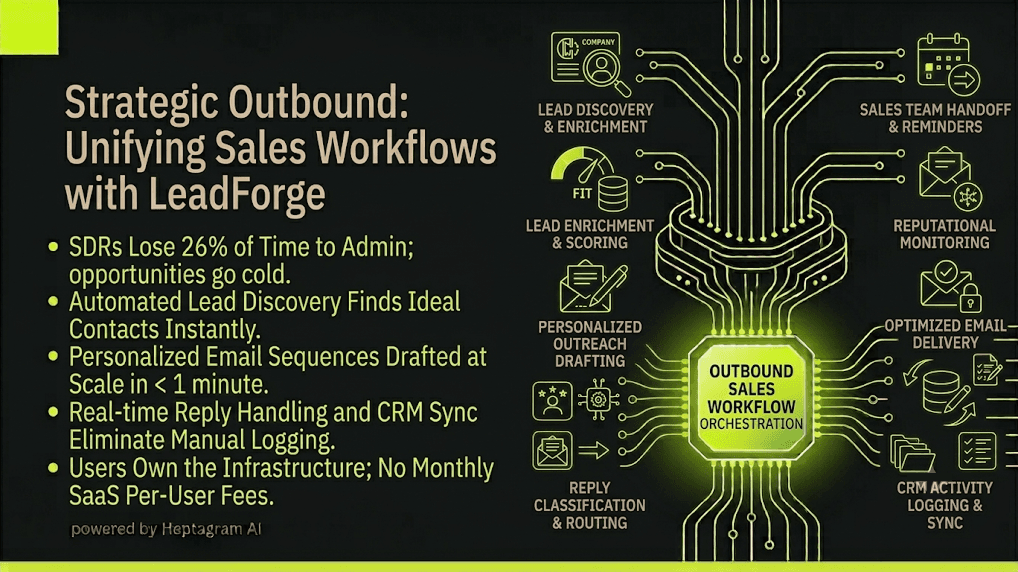
Your SDRs spend 26% of their time on administrative tasks. They research companies. They find contacts. They build lists. They write emails. They log activities in the CRM. They are not selling. They are prospecting.
A typical outbound sales workflow looks something like this: an SDR researches a target account. They find the right contact on LinkedIn. They look up the email address. They write a personalized email. They send it. They log the activity in the CRM. They set a follow-up reminder. Five logins, five systems, and critically five places data can silently fall out of sync.
The average B2B lead waits 42 hours for a first response. By then, the opportunity is often cold or gone to a competitor.
The Fragmentation Tax
Every handoff between tools is a place data can go stale or get lost. A contact is found in LinkedIn. Someone has to manually add them to the prospecting tool. An email is sent. Someone has to manually log it in the CRM. A reply comes in. Someone has to manually update the CRM status. A meeting is booked. Someone has to manually add it to the calendar.
By 2026, 85% of B2B interactions will be AI-mediated. AI SDRs are generating leads, and intent platforms are scoring accounts. Bain & Company reports that early AI deployments in sales that combine intelligence with outreach have boosted win rates by more than 30%.
| Fragmentation Point | What Goes Wrong |
|---|---|
| LinkedIn → Prospecting tool | Contact data must be copied manually; errors introduced |
| Prospecting tool → Email | Email content must be drafted manually; quality varies |
| Email → CRM | Replies must be logged manually; context gets lost |
| CRM → Calendar | Meetings must be scheduled manually; double bookings occur |
| Any tool → Reporting | Pipeline metrics require manual CRM export |
None of these failures show up as a single dramatic outage. They show up as a slow accumulation of dropped signal. Leads who are not followed up on fast enough. Meetings that are not scheduled. Reporting that never quite reconciles.
The Industry Data
According to the 2026 Sales Automation Report, organizations using AI-automated prospecting tools are generating 44% more sales-qualified leads. SDRs and AEs can expect to cut prospect research time by 34% and email drafting by 36%. More time goes into discovery calls, building buying-committee consensus, and closing deals.
The same report found that organizations using AI-powered sales engagement reduce sales cycle length by 20% and increase win rates by 15%.
How It Actually Works: The Technical Breakdown
Automating outbound prospecting requires three core technical components working in sequence.
Automated Lead Discovery and Enrichment
The system connects to your CRM and existing customer data. It identifies your ideal customer profile based on closed-won deals. It uses this profile to find similar companies using public data sources and intent signals.
The system enriches lead data automatically. It finds company information. It identifies decision-makers. It verifies email addresses. It scores leads based on fit and intent. The output is a list of qualified, enriched leads ready for outreach.
Personalized Email Generation at Scale
The system generates personalized email sequences for each lead. This is not generic template generation. It uses your successful outreach patterns to create contextually relevant emails. It incorporates company information, industry signals, and personalization tokens.
The emails are reviewed by the system for deliverability. It checks SPF and DKIM records. It monitors sender reputation. It optimizes send times based on open rate patterns.
Real-Time Reply Handling and CRM Sync
The system monitors inboxes for replies using IMAP API. It classifies each reply as interested, not interested, out of office, or automated. It routes interested leads to the sales team. It logs all interactions in the CRM via REST API.
The system updates the CRM in real time. Lead statuses change automatically. Activities are logged. Next steps are generated. No manual data entry is required.
System Architecture Summary
| Component | Technology | Purpose |
|---|---|---|
| Lead Discovery | Public data APIs + intent scoring | Find and score target accounts |
| Email Generator | Template engine + personalization tokens | Generate personalized sequences at scale |
| Inbox Monitor | IMAP API + classification model | Detect and categorize replies |
| CRM Integrator | REST API + webhooks | Log all interactions in real time |
| Deliverability Engine | SPF/DKIM checker + reputation monitor | Optimize email delivery |
Comparison Table
| Metric | Manual/Legacy Approach | LeadForge Automated Approach |
|---|---|---|
| Lead Research Time | 15-20 minutes per lead | < 30 seconds per lead |
| Email Drafting Time | 5-10 minutes per email | < 1 minute per email |
| Response Time to Leads | 42 hours average | < 1 hour average |
| Cost Model | Per-seat SaaS subscriptions ($200+/user/month) | One-time build + your own infrastructure |
Honest Failure Modes
The automation is not perfect. Here is what it cannot do.
Complex Deal Negotiation
The email generation system handles initial outreach and follow-ups. It does not handle complex deal negotiations. These require human judgment and relationship-building. The system flags interested leads for sales team handoff.
Relationship Building
The automated system can engage leads. But it cannot build deep relationships. It cannot establish trust. It cannot navigate complex organizational politics. Sales professionals are still required for strategic relationship management.
Email Deliverability Edge Cases
The system optimizes for deliverability. But email deliverability is influenced by many factors beyond the system's control. Domain age, sender reputation, and recipient spam thresholds all affect deliverability. The system monitors and flags deliverability issues but cannot guarantee 100% delivery.
The Solution: LeadForge
LeadForge is Heptagram AI's lead generation and sales engagement system. It connects your existing CRM and outreach tools instead of replacing them.
Most lead generation tools are built as standalone platforms. You pay a monthly subscription per user. You migrate your lead data into their system. You become dependent on their roadmap. This is the SaaS model.
LeadForge works differently. It integrates with your CRM, your email, and your prospecting tools. It orchestrates the data flow between them. It automates the manual steps that slow down sales.
Why you own the infrastructure
When you use LeadForge, you are not renting a platform. You are building an automation layer on top of your own infrastructure. The system runs on your cloud account or on your own servers. You control the data. You control the security. You control the updates.
No monthly subscription fees per user. No vendor lock-in. No surprise price increases. You pay for the build once. You maintain control forever.
What LeadForge automates in sales
- Automated lead discovery and enrichment
- Personalized email generation at scale
- Real-time reply handling and CRM sync
- Lead scoring based on fit and intent
- Sales activity logging and pipeline tracking
The system runs continuously. It processes leads as they are discovered. It updates your CRM in real time. Your SDRs stop doing prospecting admin. They start selling.
FAQ
How long does it take to implement LeadForge for sales automation?
Implementation typically takes 3-5 weeks, depending on your CRM API complexity and existing tech stack. We handle the integration, testing, and deployment. Your team provides access credentials and configures the scoring rules.
Does LeadForge replace my existing CRM?
No. LeadForge integrates with your CRM. Your data stays where it is. The system only reads and updates data through your CRM's API. No migration is required.
What is the ROI timeline for automating outbound prospecting?
Most sales teams see positive ROI within 2-3 months. The automation reduces research time by 34% and increases SQLs by 44%. The cost savings from reduced labor and eliminated SaaS subscription fees typically exceed the implementation cost within the first quarter.
Conclusion & CTA
Outbound prospecting is a solved technical problem. The technology exists. The APIs are available. The cost of not automating is measurable and growing.
Your SDRs did not join your sales team to do research. They joined to close deals. LeadForge removes the administrative friction so they can focus on what matters.
Book a zero-risk 15-minute scoping call to map your biggest operational bottleneck. We will tell you if automation makes sense for your sales team. And we will tell you if it does not.
[Book Your Scoping Call]
Want a system like this built for you?
Book a discovery call and we'll scope what it takes to automate your workflow.
Book a discovery call